42
Pellets
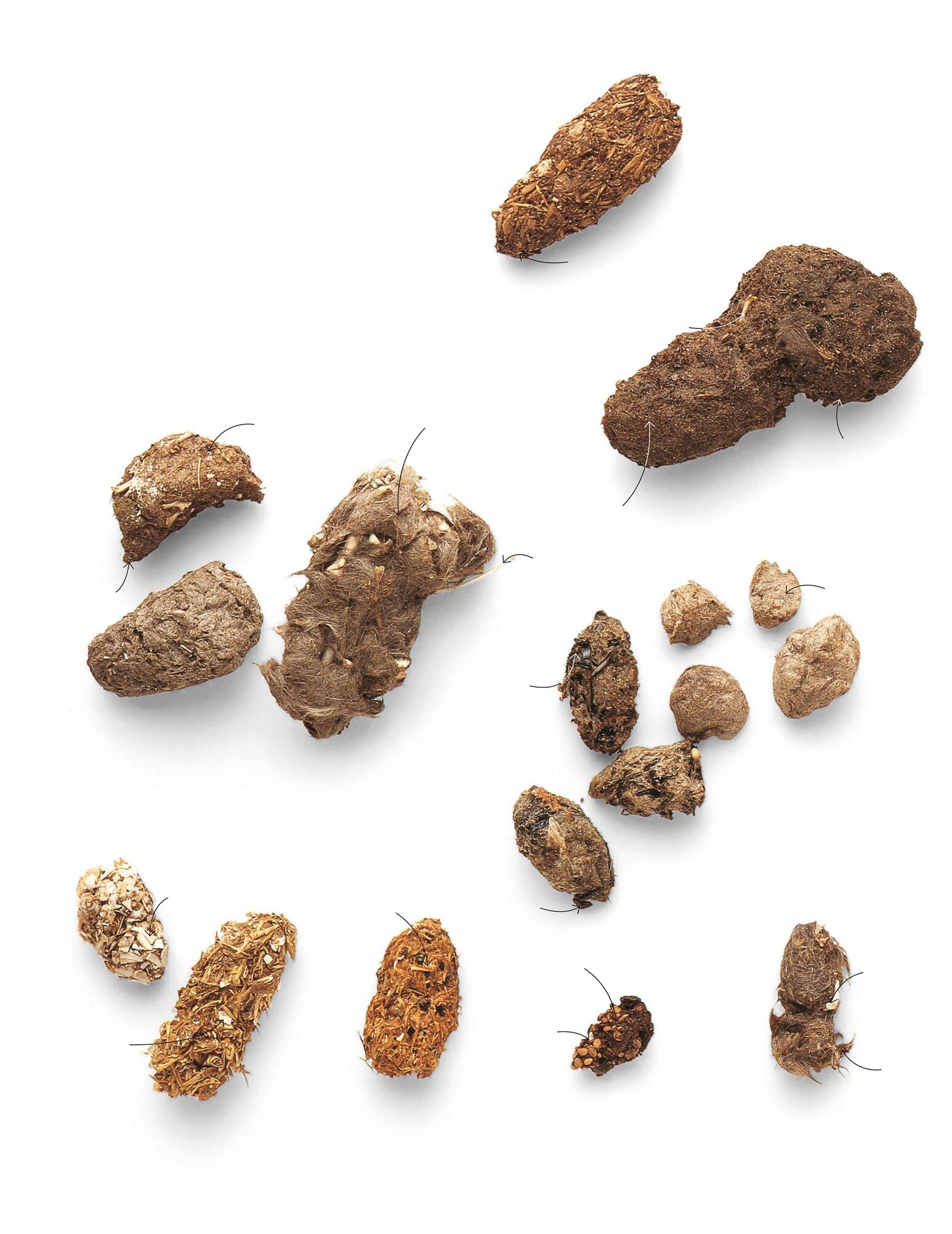
As they have no teeth, predatory birds
like owls cannot chew their food. Instead,
they rip their prey apart or eat it whole.
This means that they swallow large
amounts of indigestible bones, fur, and
feathers. They regurgitate these items
in the form of pellets.
Pellets in open ground
The pellets of the short-eared
owl are cylindrical with rounded
ends. This owl does not drop
its pellets from a perch, but
scatters them on tufts of grass.
Rounded ends
Rodent
limb bone
Blunt ends
Smooth
dark crust
Beneath a roost
The smooth pellets of the barn
owl are often found in small
piles beneath roosts in barns.
Older pellet
starting to
disintegrate
Recent
pellet
Pointed
ends
Bones and fur
Tawny owls eat shrews, mice, voles,
and smaller birds. Their smooth pellets
often have pointed ends. Older
pellets often crumble to reveal a mass
of protruding bones and tangled fur.
Beetle
wing-case
Protruding
bone
Earth and fur
A varied diet
These pellets are from
little owls. The smaller pellets
contain earth, produced by a
meal of earthworms, and fur.
The larger pellets reveal beetle legs and
wing-cases among the earth and fur.
Beetle leg
Beetle wing-
cases mixed
in with plant
material
Shell fragments
Seed-cases
mixed
with shell
fragments
Wader pellets
Wading bird pellets often
contain shell fragments.
Crow pellets
Crow pellets often
contain insect remains
and plant stalks.
Seeds
Metal foil
Songbird pellets
This songbird pellet
contains metal foil
among the seeds.
Rodent
limb
bone
Fur
Falcon pellets
Falcon pellets contain
bird, mammal, and
insect remains.